
Precious Stones in the Bible: Their Meaning and Where They Appear
Precious stones in the Bible appear most vividly on the high priest’s breastpiece in Exodus and in the foundations of the New Jerusalem in Revelation. Both descriptions name twelve stones, not a settled list of seven. Their settings tell us more than a color chart can: one list bears the names of the twelve tribes of Israel, while the other belongs to a vision of a restored city. If you came looking for a fixed spiritual power attached to each gem, the passages themselves point us in a different direction.
I would begin with the text before choosing a modern stone name. Ancient gemstone names crossed Hebrew, Greek, Latin, and English, and some identifications remain uncertain. We can appreciate their beauty and symbolism without pretending every biblical word maps neatly to a mineral in a jewelry store. The first place to look is Aaron’s priestly garment.

Where do precious stones in the Bible appear?
These settings should not be merged into one universal gemstone chart. In Exodus, precious stones are part of a priestly garment made for Israel’s worship. In Ezekiel, stones appear in poetic judgment addressed to the king of Tyre. In Revelation, gemstones furnish an apocalyptic vision. The words “stone” and “gem” recur, but the literary purposes differ. Asking what the passage is doing protects us from assigning an invented meaning to every item on a list.
It helps to keep three questions together: Where is the stone named? Who or what bears it? What does the surrounding text actually say about it? The Catholic Encyclopedia’s historical survey notes both the major biblical lists and the difficulty of matching ancient names to present-day minerals. That caution is still useful, even where its older identifications deserve fresh checking.

The twelve stones of the breastplate on Aaron’s breastpiece
The priestly breastpiece, also called a breastplate in some English Bibles, was made for Aaron as high priest. Exodus describes four rows of three stones. Each stone was engraved with a name corresponding to one of the twelve tribes of Israel. That is the text’s own explanation of the count and the stones engraved with names. The garment brought the tribes into the worship setting; it was not a guide to twelve different healing vibrations.
The design in Exodus
“And thou shalt set in it settings of stones, even four rows of stones: the first row shall be a sardius, a topaz, and a carbuncle: this shall be the first row. And the second row shall be an emerald, a sapphire, and a diamond. And the third row a ligure, an agate, and an amethyst. And the fourth row a beryl, and an onyx, and a jasper: they shall be set in gold in their inclosings. And the stones shall be with the names of the children of Israel, twelve, according to their names, like the engravings of a signet; every one with his name shall they be according to the twelve tribes.”
Exodus 28:17-21 (KJV)
Read the final sentence again. It explains why there are twelve stones: the names of the tribes. The familiar labels in the King James Version include jasper and sapphire, emerald and amethyst, agate and onyx, alongside sardius, topaz, carbuncle, diamond, ligure, and beryl. But the English word “diamond” here does not prove that the ancient Hebrew term denoted a modern cut diamond. Ancient gemstone names and modern mineral identification are a separate historical problem.
How the rows and names fit together
The four rows make a visible arrangement, but the significance explicitly supplied by the passage lies in the tribal names. I think that is more moving than a hidden code for each color: the people are remembered together. Exodus 39:10-14 recounts the completed work and repeats the twelve-stone design. It is a construction report, not a second, unrelated list. The same list sounds slightly different when translations choose different English gem names, which is why a reader should keep an open Bible beside any infographic.
The finished breastpiece
“And they set in it four rows of stones: the first row was a sardius, a topaz, and a carbuncle: this was the first row. And the second row, an emerald, a sapphire, and a diamond. And the third row, a ligure, an agate, and an amethyst. And the fourth row, a beryl, an onyx, and a jasper: they were inclosed in ouches of gold in their inclosings. And the stones were according to the names of the children of Israel, twelve, according to their names, like the engravings of a signet, every one with his name, according to the twelve tribes.”
Exodus 39:10-14 (KJV)
The high priest breastpiece also belongs to a larger garment with onyx shoulder stones. Those are distinct from the twelve individual gems across the chest. They too bear tribal names. When someone adds them to the breastpiece list and announces fourteen “special stones,” the count has changed because two different parts of the garment have been combined. The distinction is simple but useful.
“And thou shalt take two onyx stones, and grave on them the names of the children of Israel:”
Exodus 28:9 (KJV)

What about the Urim and Thummim?
The Urim and Thummim are mentioned in connection with the priestly breastpiece, but Scripture does not identify them as the twelve gemstones. Their nature and use remain debated. I would be wary of confident diagrams that label a particular gem as one of the Urim and Thummim. The Jewish Bible Quarterly study of the breastplate gems illustrates why translating and identifying the stones is already a complex task before a theory about the priestly objects is added.
There is room for careful study here. The breastpiece belongs to a setting of priestly service and judgment, and later interpreters have asked how its features functioned. The text gives us a visible garment and named tribes. It gives much less detail about how the Urim and Thummim worked. That difference between clear description and open question should guide any explanation of gemstones in the Bible.
Precious stones in Ezekiel’s image of Tyre
Ezekiel 28:13 places precious stones in an address to the king of Tyre. The prophetic passage uses lavish Eden imagery within a larger judgment on pride and splendor. It is tempting to turn the list into a chart of the king’s personal virtues or to claim that each stone conveys spiritual energy. The text does not do that. Its force comes from the contrast between extraordinary beauty and the judgment that follows in the chapter.
The prophet’s jeweled image
“Thou hast been in Eden the garden of God; every precious stone was thy covering, the sardius, topaz, and the diamond, the beryl, the onyx, and the jasper, the sapphire, the emerald, and the carbuncle, and gold: the workmanship of thy tabrets and of thy pipes was prepared in thee in the day that thou wast created.”
Ezekiel 28:13 (KJV)
Here the stones belong to the king of Tyre imagery. They are part of a prophetic portrait, not a separate system of gemstone meanings. The list resembles names readers have just seen in Exodus, but it is shorter in this English translation. That difference is another reason to resist a rigid one-to-one map across passages. A stone can serve beauty in one setting and prophetic irony in another.

The gemstones in Revelation’s New Jerusalem
The New Testament closes with a vision of a new heaven and earth, and Revelation describes a city with jeweled foundations. Revelation 21:19-20 names twelve layers or foundation stones, from jasper to amethyst. In the same vision, the walls have twelve foundations bearing the names of the twelve apostles. The emphasis is not on a market price for the stones. Their splendor contributes to the visionary picture of God’s dwelling and a restored community.
The city foundations
“And the foundations of the wall of the city were garnished with all manner of precious stones. The first foundation was jasper; the second, sapphire; the third, a chalcedony; the fourth, an emerald; The fifth, sardonyx; the sixth, sardius; the seventh, chrysolyte; the eighth, beryl; the ninth, a topaz; the tenth, a chrysoprasus; the eleventh, a jacinth; the twelfth, an amethyst.”
Revelation 21:19-20 (KJV)
The New Jerusalem foundations include familiar words such as jasper and sapphire, emerald and amethyst, as well as names many readers rarely use. Revelation is visionary literature. A foundation stone in this scene belongs to a picture of the city’s glory and permanence. It is not a command to buy twelve modern gems or to rank believers by the stone they prefer.
Does Revelation copy Aaron’s breastpiece exactly? The shared number twelve and overlapping names invite comparison, but the order and labels are not identical. The priestly garment bears the twelve tribes of Israel; the city vision names the twelve apostles on its foundations. I think it is fair to notice the pattern of remembered people and divine beauty. It is less fair to insist that every modern gemstone pair is an exact ancient match.
That vision connects biblical hope with the story’s end, which is why a reader may also want Lumencross’s collection of Easter Bible verses. The connection is resurrection hope, not a secret code in gemstones.

Why gemstone names differ between Bible translations
Hebrew stone names in the Hebrew Bible did not develop under today’s mineral classification. The Septuagint translations into Greek and the Vulgate translations into Latin add further layers of naming before modern English versions choose their words. One ancient word could be tied to color, origin, or use rather than chemical composition. That makes a chart promising “the exact twelve stones” more certain than the evidence permits. Even the ancient writers and translators did not always agree.
A modern reader can compare translations without assuming one version is careless. The underlying terms are genuinely difficult. A sapphire in an ancient list need not correspond to a jeweler’s modern sapphire; an onyx or beryl may cover a different range of materials than the shop label. Modern mineral identification is a historical and geological judgment, not a replacement for the biblical message. This is why the stone’s role in its passage is more secure than a claim about its precise chemical structure.
If you choose jewelry inspired by biblical imagery, let the meaning come from Scripture and your own thoughtful intention. Lumencross offers Christian jewelry as a modern expression of faith; it should not be confused with the priestly breastpiece or a guaranteed spiritual effect. Its guide to Bible verse bracelets is a related way to think about pairing a wearable reminder with actual biblical words.

What are the 7 precious stones in the Bible?
There is no standard list called “the seven precious stones” in the Bible. This is the seven precious stones myth that search results sometimes repeat. The two most prominent designed lists we have read use twelve: the breastpiece’s twelve tribal stones and the New Jerusalem’s twelve foundations. Other passages name individual stones or smaller groups, but the Bible does not arrange them into an authoritative set of seven with fixed personal meanings.
If someone offers a seven-stone chart, ask which passage supplies the seven and whether its context supports the assigned meanings. That question is more useful than arguing over a color palette. You can still appreciate seven stones in a piece of art or jewelry. Just describe the design as a modern choice rather than as a biblical command. The number twelve in Exodus and Revelation has an explicit relationship to people named in those passages.
So if a friend asks, “What are the 7 precious stones in the Bible?” I would gently answer that Scripture offers no authoritative seven-stone list. It is better to read the twelve-stone passages and ask what each scene says about the people and city it depicts.

Do gemstones have spiritual powers in Scripture?
The Bible can use gemstones to convey beauty, value, and splendor. It does not say that owning a jasper, amethyst, or onyx gives someone divine favor or protection. Stones do not have inherent spiritual power in these passages. That distinction matters for Christian readers and for anyone shopping for a meaningful gift. The symbolic value of gemstones comes from their place in a story or a person’s interpretation, not from a guaranteed outcome stored in the mineral.
I can picture someone holding a ring given at a milestone and remembering the prayer that came with it. That memory may be precious. The metal or stone is not the source of grace. I think the wiser gift is the conversation and care that accompany it. A friend might ask, “Which passage matters to you, and why?” Then the gift points back to a real text and a real relationship. If we let the jewel carry a promise it cannot keep, we put a burden on the recipient. If we let it be a reminder, it can sit comfortably within an ordinary life of faith.
The meaning of a gift can point back to a passage and a relationship; it does not reside in the mineral itself.
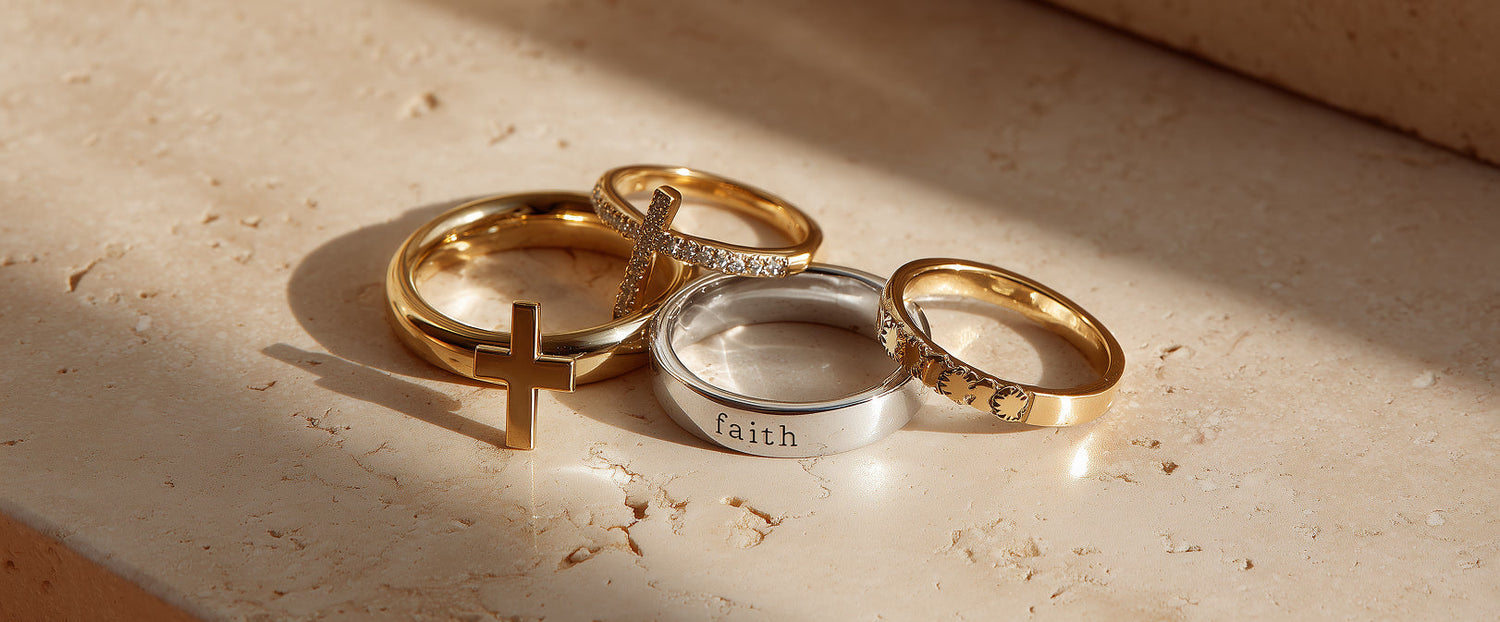
Lumencross’s Christian rings, cross necklaces, Christian gifts, and Christian apparel can mark an occasion or open a faith conversation today. They are contemporary expressions, not replicas of Aaron’s sacred garment. For a reflection on divine character rather than the powers assigned to objects, see its article on the characteristics of God.
Frequently asked questions
Do the twelve stones correspond to today’s monthly birthstones?
Exodus attaches tribal names to its stones, not calendar months or birthdays. Modern birthstone lists should be described on their own terms rather than read back into the priestly design.
Why might one Bible say “sardius” and another “carnelian”?
Translators must choose a present-day word for an ancient gem term. Sometimes two English names reflect different judgments about the likely color or mineral. Read the passage’s function before treating either shop label as exact.
Can anyone make an exact replica of Aaron’s breastpiece?
An artist can make a thoughtful reconstruction of its four-row design. Because several ancient stone names remain uncertain, a claim to reproduce every mineral exactly would go beyond the evidence.
Are gemstones themselves forbidden to Christians?
The Bible uses precious stones in priestly and visionary settings. The caution is about claiming powers or guarantees for the object, not about its beauty or a thoughtful modern use.
Where should I start reading?
Begin with the quoted Exodus and Revelation passages above. Read each in its wider chapter, then compare translation notes if a stone name raises a question.
The meaning begins with the passage
Precious stones in the Bible are striking because they are placed within worship, prophecy, and vision. Aaron’s breastpiece bears Israel’s names; Ezekiel uses jeweled splendor in a warning; Revelation imagines a city whose foundations shine. The Bible’s meaning is tied to those scenes. We can enjoy the colors and the craft while staying honest about uncertain mineral names and resisting promises the text never makes. That is a better way to understand gemstones in the Bible than assigning each one a private power.
If you want another path into biblical meaning, Lumencross’s reflections on grace and faith of a mustard seed keep the focus on the words of Scripture. A stone can be a reminder, but the passage deserves the final word.