
What Clothes Did Jesus Wear? Biblical and Historical Context
What clothes did Jesus wear? The Gospels directly mention a tunic, other garments, the edge of his garment, and a robe soldiers put on him during their mockery. His sandals are strongly suggested by the words of John the Baptist and the travel instructions Jesus gave his disciples. A tunic, outer cloak, belt, and sandals also fit the clothing of many Jewish men in first-century Galilee. We should be careful about the details no source gives us, including the exact colors and fabric of his everyday clothes.
I find it helpful to ask a simple question of each claim about Jesus clothing in the Gospels: does a Gospel actually name this garment, or are we picturing what was common in Roman Judea? Both kinds of evidence can be useful. They just carry different weight. A modern cross necklace may express faith, but it is not historical evidence about Jesus’ wardrobe. The first distinction comes from the crucifixion scene, where the wording about Jesus’ clothing is unusually specific.

What clothes did Jesus wear? The Gospel record
John’s account of the crucifixion is our clearest direct description. Roman soldiers divide Jesus’ garments, but they do not tear his coat or tunic because it was woven without a seam. John 19:23-24 gives the detail; it does not say that Jesus wore that same tunic every day, name its material, or assign it a color. Jesus seamless tunic is a fair description of the garment in that scene. A claim that it was white or made of a particular fiber goes beyond the text.
John’s account of the tunic
“Then the soldiers, when they had crucified Jesus, took his garments, and made four parts, to every soldier a part; and also his coat: now the coat was without seam, woven from the top throughout. They said therefore among themselves, Let us not rend it, but cast lots for it, whose it shall be: that the scripture might be fulfilled, which saith, They parted my raiment among them, and for my vesture they did cast lots. These things therefore the soldiers did.”
John 19:23-24 (KJV)
The word rendered “coat” in the King James Version refers to the inner garment often called a chiton tunic. “Garments” in the same account refers to other clothing divided among the soldiers. The scene lets us distinguish a tunic from an outer garment of Jesus, even though John does not pause to catalogue every layer. For a close look at textile terms in the New Testament, the Religious Studies Center’s clothing and textiles study is a useful historical companion.
The Gospel of John provides the clearest direct detail. The Gospel of Matthew and the Gospel of Mark add scenes involving the border of a garment. Together, they show how Jesus clothing in the Bible appears in particular narratives rather than in a wardrobe inventory. That is a small distinction, but it keeps us from filling gaps with our favorite painting.
Another direct clue comes from people touching the border of Jesus’ garment. Mark 6:56 describes crowds seeking that touch. Matthew tells of one woman who reaches for the hem. Those stories are about her need and Jesus’ response, not about a magical property in fabric. The garment hem is still a real clothing detail in the narrative. It may help us picture an outer wrap or cloak with a reachable edge, while the precise cut remains unknown.
The garment edge in the healing accounts
“And whithersoever he entered, into villages, or cities, or country, they laid the sick in the streets, and besought him that they might touch if it were but the border of his garment: and as many as touched him were made whole.”
Mark 6:56 (KJV)
“And, behold, a woman, which was diseased with an issue of blood twelve years, came behind him, and touched the hem of his garment: For she said within herself, If I may but touch his garment, I shall be whole. But Jesus turned him about, and when he saw her, he said, Daughter, be of good comfort; thy faith hath made thee whole. And the woman was made whole from that hour.”
Matthew 9:20-22 (KJV)

What did Jesus wear? First-century Jewish clothing in ordinary life
What did Jesus wear during an ordinary day? Historical reconstruction of Jesus clothing begins with his place within first-century Judaism in Galilee during the Second Temple period. First-century Judean dress varied by season, work, wealth, and local custom, but a tunic with an outer wrap, a belt or sash, and footwear is a reasonable broad picture. That is an inference from material culture and textual comparisons, not a recovered wardrobe belonging to Jesus Christ. First-century Jewish clothing gives us a setting, not an exact personal inventory.
Jesus tunic and cloak: text and inference
The tunic was a basic garment worn close to the body. Over it, a person might wear a larger wrap or mantle. The Greek terms chiton and himation are often used to explain the distinction: an inner tunic and an outer garment or cloak. Translators may use “coat,” “robe,” “cloak,” or “garment” differently, so one English word should not carry more certainty than the passage gives. A himation cloak could provide warmth and shade, and it could be valuable in a household with few spare garments.
A belt or sash could gather a tunic for movement and hold small necessities. It makes practical sense for someone walking through the villages of Galilee, but the Gospels do not give us a daily inventory of Jesus’ belts. Likewise, wool and linen clothing are well attested in the region, yet we cannot inspect Jesus’ exact fabric. Ancient textile evidence tells us what was possible in the society; it does not identify the fiber of the coat named in John.
A piece of Christian jewelry belongs to modern faith expression, not first-century dress. People sometimes reduce the historical answer to “Jesus tunic and cloak.” I understand why: it gives a clear mental picture. I would keep the two parts of that picture in view, though. A tunic is named directly in the Passion account; the precise everyday cloak comes from the broader pattern of first-century Jewish clothing and Gospel references to a garment edge.
A simple first-century outfit can help us read a scene, but it should not turn into a costume rule for every artist or believer. The historian Joan E. Taylor’s discussion of what Jesus wore shows how the Gospels and the material culture of the Dead Sea region can be read together. Joan E. Taylor is one historian who distinguishes textual evidence from later assumptions. That approach also reminds us that a later devotional image is not an eyewitness sketch.

Did Jesus wear sandals?
What did Jesus wear on the road? The Gospels suggest practical dress for walking and travel, but they do not preserve a pair of shoes for us to inspect. Sandals are the clearest footwear inference.
Jesus sandals are a strong historical inference, though the Gospels do not offer a close description of a pair he owned. John the Baptist speaks of being unworthy to loosen the strap of the one coming after him. Mark 1:7 gives that line in older English as the “latchet of whose shoes.” Jesus also tells his disciples to travel with sandals and not to put on two coats. These are not measurements of his own footwear, but they place sandals firmly in the world of his ministry.
Sandals and travel in the Gospel setting
“And preached, saying, There cometh one mightier than I after me, the latchet of whose shoes I am not worthy to stoop down and unloose.”
Mark 1:7 (KJV)
“And commanded them that they should take nothing for their journey, save a staff only; no scrip, no bread, no money in their purse: But be shod with sandals; and not put on two coats.”
Mark 6:8-9 (KJV)
The instruction against two tunics on mission concerns what the disciples should carry. It should not be flattened into a claim that Jesus never owned a second garment. Mark’s wording does make the ordinary travel context concrete: staff, money pouch, food, sandals, and extra clothing were all practical questions. Foot washing in Gospel-era households also makes sense against dusty roads and open footwear, though a foot-washing scene by itself does not tell us the style of Jesus’ sandals.
A Christian ring can be a meaningful reminder today, but it tells us nothing about the construction of Jesus’ sandals.
What did the edge of Jesus’ garment look like?
Readers sometimes ask whether the hem of garment was a specially designed fringe. Jewish garment fringes and tassels on garment corners belong to the wider Jewish world of the period. A tassel could mark a corner, but the Gospel story does not specify its construction, and the Gospel wording about the border can invite that question. But the healing accounts do not give us enough detail to reconstruct its exact shape. We can say people reached the garment edge. We should be more cautious before describing its thread color or knot pattern.
I can imagine standing at the edge of a crowded street and trying to picture the scene. The detail that stays with me is not a fabric diagram. It is a person reaching through a crowd in need, and Jesus turning to her. That does not make the clothing irrelevant. The accessible border helps us see how close the encounter was. Still, the story’s center is the person and the response she receives. When I read it that way, I feel less tempted to turn the garment into an object with power of its own. The text does not ask us to do that.
Mark’s crowd scene likewise speaks of people seeking healing. It does not promise that a garment, replica, or modern product can heal anyone. For broader reflection on the person at the center of Christian faith, Lumencross’s article on the characteristics of God is a separate reading path.

Was the purple or scarlet robe Jesus’ normal clothing?
No. The purple robe of mockery belongs to the Passion story. John says soldiers put a purple robe on Jesus while mocking him. Matthew says they put a scarlet robe on him. These are accounts of an imposed garment in a cruel scene, not a description of what Jesus chose to wear while teaching in Galilee. If someone asks what color robe did Jesus wear, this distinction is the first thing I would explain.
The robe placed on Jesus
“And the soldiers platted a crown of thorns, and put it on his head, and they put on him a purple robe,”
John 19:2 (KJV)
“And they stripped him, and put on him a scarlet robe.”
Matthew 27:28 (KJV)
A Christian gift may use royal colors symbolically today; that does not turn the soldiers’ mocking robe into Jesus’ ordinary clothing.
Why do the accounts use different color terms? The passages describe the same kind of royal mockery, while their wording differs. We cannot use that difference to recover the exact shade of Jesus’ everyday cloak. Scarlet robe in Matthew and purple in John name a temporary humiliation imposed by Roman soldiers. The wider crucifixion narrative deserves a careful reading in its own right; a related Lumencross collection of Easter Bible verses can help readers follow that story.

What did Jesus teach with clothing imagery?
Jesus sometimes used ordinary garments to make an ethical point. In Matthew 5:40, he speaks about a coat and cloak in the setting of a dispute and challenges his hearers toward a startling generosity. The statement is teaching, not a record of which cloak he owned. Keeping genre clear matters here: cloak in Jesus teaching and a garment in the Passion account function differently.
A coat and a cloak in Jesus’ teaching
“And if any man will sue thee at the law, and take away thy coat, let him have thy cloak also.”
Matthew 5:40 (KJV)
Parables and sayings about wedding clothes, new cloth, and what people wear also draw on familiar daily life. A sewn garment was useful and costly; people did not treat clothing as endlessly disposable. Such images illuminate a teaching, but they do not give us a new detail about the color of Jesus’ own clothing. In other words, we can learn why clothes mattered without turning every garment metaphor into a historical wardrobe clue.
A modern Christian may choose Christian apparel as an expression of faith. That choice belongs to today. It should not be presented as a replica of a first-century garment or as a measure of anyone’s devotion. Lumencross’s guide to Bible verse bracelets offers another way to think about carrying words of faith into ordinary life.

What can we say about fabric, color, and headwear?
What clothes did Jesus wear in terms of color? No source tells us the shade of his normal tunic or cloak. The colored robe in the Passion was placed on him by others. For daily dress, we are left with plausible regional patterns and an honest limit.
What fabrics can history support?
The Gospels give no complete description of Jesus clothing in the Bible. We can discuss common materials in clothing in Roman Judea, and a head covering may have been practical against sun or weather. Yet neither point identifies an item in Jesus’ own wardrobe with certainty. Wool and linen clothing were available, but the seamless tunic’s specific fiber is not named. A belt or sash would fit everyday Galilean clothing, but its size and color are unknown.
This is where historical inference is useful and limited. Archaeological textiles, images, and written descriptions can show how people in the broader region dressed. They do not produce a photograph of Jesus. I would be wary of any illustration that labels a particular dye or cut as certain without showing a direct source. The same caution applies to claims that all Jewish men dressed alike. Place, work, household resources, and occasion all mattered.
Art, evidence, and humility
In Christian art, the long white robe has become familiar to many people. A painting can still carry devotional meaning while using the artist’s own visual language. It is not ancient textile evidence. For another meditation on Christian hope beyond appearances, see Lumencross’s reflection on what the Bible says about grace.

How should we picture Jesus’ clothing today?
A historically cautious picture might show a first-century Jewish man in a tunic, outer mantle, belt, and sandals. It would leave room for variation and avoid claiming a precise shade of cloth. The strongest direct details remain the tunic in John’s crucifixion account, the garment edge in healing stories, and the temporary robe imposed by soldiers. A picture should not blur those scenes into one outfit.
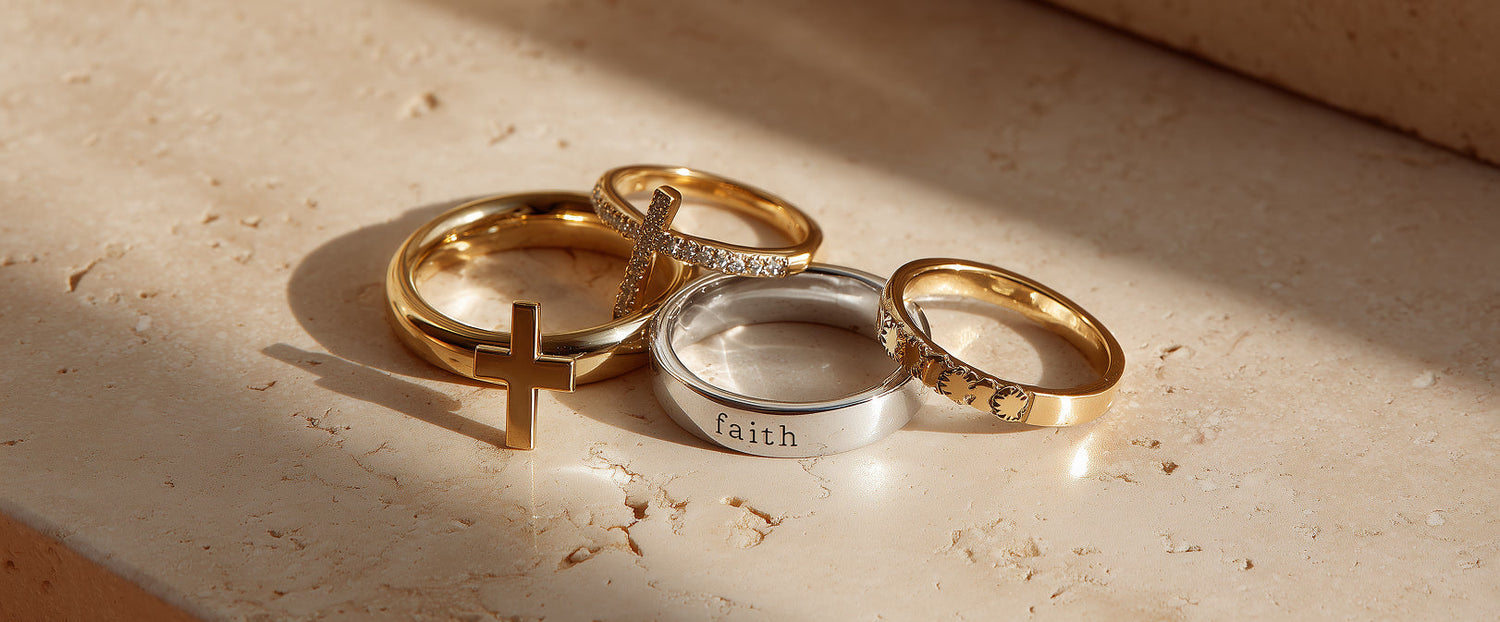
Lumencross connects contemporary faith expression with thoughtful design through cross necklaces, Christian jewelry, Christian rings, and Christian gifts. Those are modern symbols and reminders. They are not historical reconstructions or objects with spiritual power. What matters here is honesty about the past and respect for the meaning people bring to a symbol today.
If you are thinking about how faith is expressed in daily life, Lumencross’s reflection on faith of a mustard seed offers a different kind of question. It is about trust, not about reconstructing a first-century outfit.
Frequently asked questions
Did Jesus always wear a long white robe?
There is no Gospel statement that his everyday clothing was long or white. White robes in later art can express theological or artistic meaning. They do not establish a daily outfit.
Was Jesus’ tunic truly seamless?
John explicitly describes the coat taken at the crucifixion as woven from the top without a seam. That is a detail about that garment. It does not tell us who made it or what fabric it used.
Did Jesus wear a prayer shawl?
The Gospels mention the edge of his garment, and Jewish fringes are relevant historical context. They do not give a full description of a prayer shawl in the form familiar from later traditions. It is safest to speak of a garment border without claiming an exact design.
Why do John and Matthew name different robe colors?
They describe a robe placed on Jesus during mockery and use purple and scarlet language. The scene concerns ridicule of a supposed king. Neither color identifies his ordinary clothing.
Could Jesus have worn more than one tunic in his lifetime?
Yes, that is possible. The mission instruction about not taking two coats concerns what disciples carry on a journey; it is not a lifelong inventory of Jesus’ possessions.
The careful answer
Jesus clothing in the Bible gives us glimpses, not a complete portrait. The Gospel scenes are enough to answer the central question carefully, even if they leave room for uncertainty about ordinary dress.
What clothes did Jesus wear? Scripture gives us several firm clues, and history fills in a cautious outline. A tunic and outer garment are directly named, sandals fit the narrated world, and a cloak, sash, and common regional materials are plausible. The purple or scarlet robe belongs to mockery, not ordinary dress. I think the most honest answer keeps each claim close to its source and is comfortable saying when the detail is unknown.
If a drawing helps you imagine a Gospel scene, let it help. Then return to the text and ask what is actually there. That small habit makes the historical picture clearer and leaves the story’s human and spiritual meaning in view.