
Religious Necklaces: Meanings, Styles, and How to Choose
Religious jewelry can be beautiful, but beauty is only part of the decision. A necklace may hold a cross that recalls Christ’s sacrifice, a crucifix shaped by Catholic devotion, an ichthys that quietly identifies Christian faith, or words of Scripture chosen for a particular season of life. The right piece begins with what the symbol means—not merely how it looks.
When choosing religious necklaces, start with three questions: What truth or tradition should the necklace represent? How will the wearer use it? What size, material, and style will fit everyday life? Answer those in that order and the search becomes more thoughtful, whether you are shopping for yourself or choosing a gift.

What makes a necklace religious?
A religious necklace is a wearable symbol connected to belief, worship, devotion, identity, or sacred memory. For Christians, that may mean a cross, crucifix, fish, medal, rosary, saint image, mustard seed, or a pendant engraved with Scripture. The jewelry does not create faith; it gives a visible form to something the wearer already believes, remembers, or practices.
That use has deep roots. A Byzantine gold necklace in the collection of The Metropolitan Museum of Art shows that crosses appeared in personal jewelry centuries ago. The Museum of Applied Arts Cologne likewise describes religious jewelry as an expression of faith and the cross as a sign connected with Christ’s sacrifice and redemption. Materials and fashions change, but people have long used jewelry to carry identity, memory, and devotion close to the body.
For Lumencross, the purpose is similarly grounded: Christian creativity should point beyond the object toward the Gospel. Our mission is to make faith visible with beauty, courage, and truth while remembering that a pendant is a reminder—not a substitute for prayer, worship, Scripture, community, or discipleship.
The fastest way to choose a religious necklace
Use this four-part order:
- Choose the symbol and its meaning.
- Decide the purpose: daily reminder, visible witness, devotional practice, or gift.
- Match the piece to the wearer’s routine, materials, chain length, and preferred scale.
- Check whether the symbol fits the wearer’s church tradition and personal comfort.
This is a meaning before metal approach. It prevents a common mistake: finding an attractive pendant first and only later discovering that the imagery carries a tradition, practice, or message the wearer did not intend.
Religious necklace meanings by symbol
Plain cross
A plain cross centers the death and resurrection of Jesus without depicting his body. It is widely worn across Catholic, Orthodox, and Protestant communities, although design preferences vary. For many believers, it is a reminder of grace, redemption, and the call to follow Christ.
In Matthew 16:24, Jesus connects discipleship with taking up one’s cross and following him. Wearing a cross does not accomplish that calling, but it can prompt an honest question: How am I following Christ in this ordinary moment? Explore cross necklaces when that direct, recognizable symbol best fits the wearer.
Crucifix
A crucifix is a cross that includes the figure of Jesus. It emphasizes the reality of the Passion and is especially prominent in Catholic devotion, while also appearing in some Orthodox, Anglican, Lutheran, and other Christian settings. A crucifix may be worn as a personal reminder, used with a rosary, or given for occasions such as First Communion, Confirmation, or reception into the Church.
Because practice differs, a crucifix is a gift best chosen with knowledge of the recipient. It should never be presented as “more Christian” than a plain cross—or treated as merely decorative when it is devotional for the wearer.
Ichthys or Christian fish
The ichthys is the familiar outline of a fish used as a compact Christian identifier. Its Greek letters became associated with a confession about Jesus Christ, and today the symbol often communicates faith in a quieter way than a large cross.
A Christian fish necklace can suit someone who prefers subtle symbolism, appreciates early-Christian associations, or wants a conversation starter that is recognizable without being visually dominant. Look for a clean fish outline and secure attachment points; tiny or overly ornate designs can become difficult to read.
Bible verse or word pendant
A Bible verse necklace, reference pendant, or word piece connects the wearer with a particular passage or theme. Common examples include faith, grace, beloved, strength, or a chapter-and-verse reference. These pieces can mark a testimony, a baptism, grief, recovery, a new beginning, or a prayer the wearer returns to often.
Check the wording carefully. A short phrase should preserve the meaning of its source rather than turn Scripture into a detached slogan. If a pendant includes only a reference, confirm the translation and context before giving it. “Biblical necklaces” is a broad shopping phrase, but the most meaningful choice is usually specific: one passage, one memory, and one reason.
Medals, saints, and Marian imagery
Devotional medals may depict Mary, a saint, the Sacred Heart, an angel, or another image with a defined history of prayer and remembrance. These are especially meaningful within Catholic and some Orthodox traditions. The image is not a generic Christian motif; it may connect to a patron saint, sacramental occasion, pilgrimage, or established devotion.
If you do not share the recipient’s tradition, ask rather than guess. A simple question—“Is there a saint or devotion that matters to you?”—turns a potentially generic present into a deeply personal one.
Rosaries and prayer-bead necklaces
A rosary is a structured prayer aid, not simply a long beaded necklace. Some people wear a rosary reverently; others carry it or use it only for prayer. Customs differ by community, family, and individual conscience. When shopping for rosaries and medals, treat the form with the same respect you would give any object tied to someone’s worship practice.
Mustard seed
Mustard seed jewelry refers to Jesus’ teaching about faith and the mustard seed. It often appeals to someone who wants a small visual reminder that faithfulness is not measured by outward size. The symbol can be encouraging, but it should not be used to promise that a pendant itself will produce a result or overcome a problem.
Cross or crucifix: which should you choose?
Choose a plain cross when the wearer wants a broadly recognized Christian symbol, prefers a simple silhouette, or comes from a tradition that commonly uses an empty cross. Choose a crucifix when the wearer values a visible representation of Christ’s Passion or practices a devotion in which the crucifix has a familiar place.
For a gift, consider:
- What does the recipient already wear?
- Does their church commonly use a cross, crucifix, or both?
- Is the gift connected to a Catholic sacrament or another specific milestone?
- Would they prefer a quiet reminder or a clearly devotional image?
If you are uncertain, a simple cross is often the more broadly familiar option, but familiarity is not the same as universal preference. Respectful knowledge of the person matters more than a generic rule.
Choose by purpose, not only by appearance
A daily reminder
For everyday wear, prioritize comfort and durability. A modest pendant with a smooth back is less likely to catch on clothing. A chain that sits securely under or over a shirt makes the necklace easier to wear without constant adjustment.
A visible expression of faith
Someone who wants a recognizable statement may prefer a larger cross, a stronger silhouette, or a design that sits over clothing. The goal is not performance. A visible symbol can open a conversation, but character, kindness, and truth give that conversation substance.
A devotional practice
Crucifixes, rosaries, and medals may accompany prayer or recall a specific devotion. Accuracy and tradition matter more here than trend. Learn what the imagery represents, how the wearer uses it, and whether any blessing or sacramental practice is important to them.
A meaningful gift
For baptisms, confirmations, graduations, weddings, anniversaries, and seasons of loss or renewal, choose a symbol tied to the occasion. Add a note explaining why you selected it. The note often turns a beautiful object into a lasting memory.
Materials and care: read the item details
Religious meaning does not remove practical concerns. Skin sensitivity, climate, work, exercise, water exposure, and care habits all affect whether a necklace will actually be worn.
Common jewelry descriptions include sterling silver, stainless steel, gold-filled, gold vermeil, gold plating, solid gold, and various base-metal alloys. These terms are not interchangeable. Plated finishes can wear differently from solid metal, and care instructions vary by construction. Do not assume every necklace is waterproof, tarnish-proof, hypoallergenic, or safe for every skin type.
Before buying:
- Read the exact material specification for the pendant and chain.
- Check whether the finish is plated, filled, vermeil, or solid.
- Follow the item’s care instructions for water, fragrance, sweat, and storage.
- Confirm the clasp type and chain strength for the pendant’s weight.
- Ask a qualified professional about known metal allergies or medical concerns.
Browse Christian jewelry by style, then open the individual product page for the current material and care details. Product-level information is more reliable than a blanket assumption about an entire collection.
Chain length and pendant scale
Chain length changes where a symbol sits and how easily it layers with clothing. As a general visual guide, shorter chains tend to sit near the collarbone, medium lengths often fall at the upper chest, and longer chains create a lower, more prominent line. The exact position depends on neck size, body shape, clothing, chain style, and pendant weight.
Pendant scale matters just as much:
- Small pendants feel discreet and layer easily.
- Medium pendants balance visibility with everyday versatility.
- Large pendants make a stronger statement and need a chain suited to their weight.
Measure a necklace the wearer already likes. Lay it flat, note the full chain length, and compare the pendant dimensions with the new item’s specifications. This is more dependable than relying on gendered labels or model photography alone.

Religious necklaces for women and guys—without rigid rules
Searches for “religious necklaces for guys” often surface thicker chains, larger pendants, darker finishes, dog-tag shapes, or rugged textures. Women’s collections may emphasize fine chains, smaller pendants, polished finishes, or layering. These can be useful browsing shortcuts, but they are not rules.
A man may prefer a small silver cross tucked beneath a shirt. A woman may want a substantial crucifix on a heavier chain. Another wearer may choose by symbolism and proportion without using a gender category at all. Focus on chain width, pendant size, finish, wardrobe, and comfort. Personal style is more informative than a label.
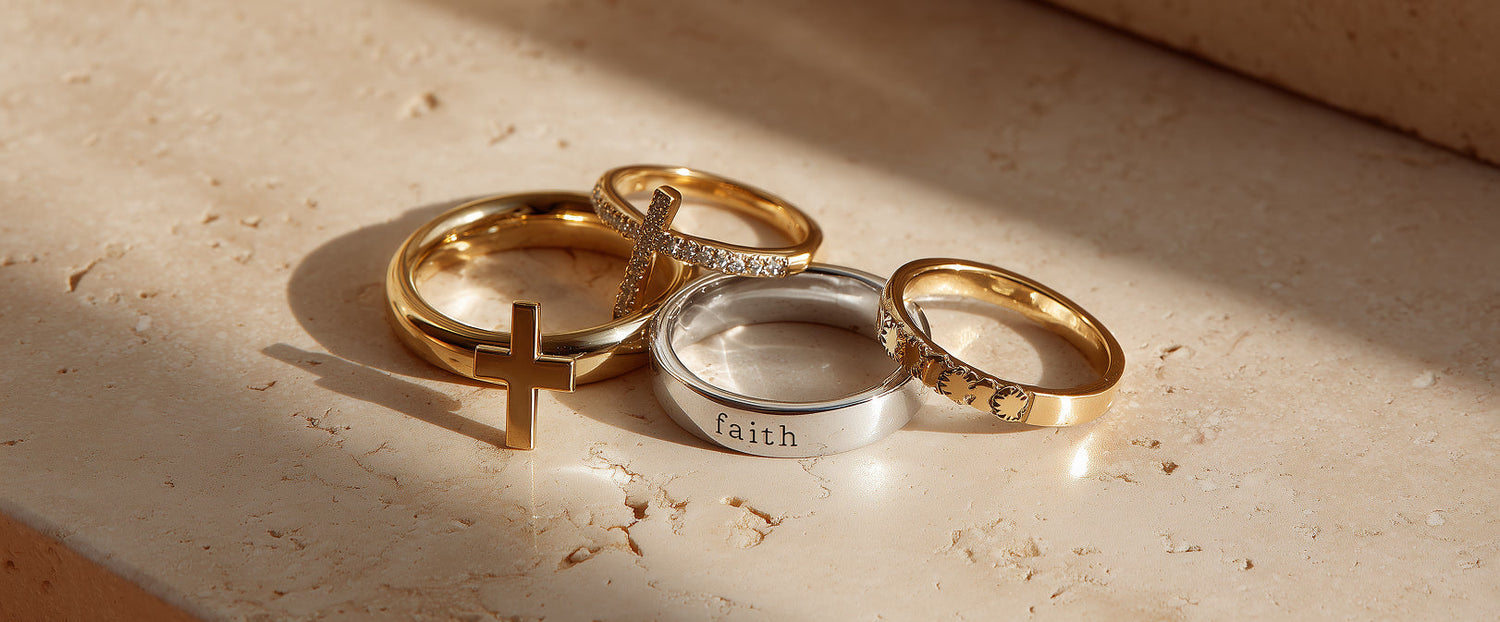
Christian rings can also complement a necklace when the wearer prefers a second faith symbol, but avoid stacking pieces simply to make a set. One well-chosen item often carries more meaning than several loosely related motifs.
How to choose a religious necklace as a gift
Start with the person, not the occasion aisle.
- Notice what metal color and chain length they already wear.
- Identify the symbol that fits their faith tradition and story.
- Choose a scale appropriate for daily wear, not only the ceremony.
- Check materials, care, clasp, and return or exchange terms.
- Include a short written message about the meaning of the gift.
For a recipient whose preferences are unknown, avoid highly specific devotional imagery unless the occasion clearly calls for it. A broadly recognized cross or a carefully chosen Scripture reference may be easier, but still verify that the recipient would welcome religious jewelry.
For someone going through grief, illness, or crisis, offer the necklace as companionship and remembrance—not as a guarantee of healing, protection, or a particular outcome. Compassion does not need a claim the jewelry cannot carry.
Respect, faith, and what jewelry cannot do
A necklace can remind, teach, honor, and invite conversation. It can mark a sacrament or hold the memory of a person and a prayer. It cannot save, protect by its own power, replace medical care, prove spiritual maturity, or make the wearer more loved by God.
Historical objects are sometimes described in connection with protective beliefs. That history is worth understanding, but Lumencross does not present jewelry as a charm or spiritual technology. Christian hope rests in Christ. The object is meaningful because of what it points toward and how the wearer responds in faith.
The same humility applies to other traditions. Do not wear a medal, rosary, or denominational symbol to mock it, flatten it into an aesthetic, or provoke a fellow believer. Curiosity and respect make room for honest differences.
A quick decision checklist
Before you choose, ask:
- Do I understand the symbol?
- Does it fit the wearer’s Christian tradition and conscience?
- Is the purpose daily wear, witness, devotion, or a milestone gift?
- Are the chain length and pendant scale comfortable?
- Have I checked the exact materials and care instructions?
- Would the wearer welcome a visible faith symbol?
- Can I explain why this particular piece is meaningful?
If the answers are clear, you are no longer buying a generic accessory. You are choosing a symbol with intention.
Frequently asked questions
What is the most common Christian necklace?
The cross is the most broadly recognizable Christian necklace symbol. Designs range from minimal empty crosses to crucifixes and historically inspired forms. “Most common” does not mean best for every person; tradition, purpose, and comfort should guide the choice.
Is a cross necklace biblical?
The New Testament does not command Christians to wear cross jewelry. It does, however, place the cross at the center of the Gospel and uses taking up one’s cross as language for discipleship. Many Christians therefore wear a cross as a reminder or expression of faith, not as a requirement.
What is the difference between a cross and a crucifix necklace?
A plain cross does not include the figure of Jesus. A crucifix does. Crucifixes are especially associated with Catholic devotion and also appear in several other Christian traditions; plain crosses are common across many denominations.
What does a fish necklace mean in Christianity?
The ichthys fish is a compact sign of Christian identity associated with an early confession about Jesus. Today it can be a subtle alternative to a cross or a conversation-opening symbol of faith.
Can I give a religious necklace to someone from a different denomination?
Yes, if you know the person would welcome it and the symbol fits their beliefs. When unsure, ask about their preferences or choose a broadly familiar design. Avoid assuming that every Christian relates to crucifixes, saints, medals, or rosaries in the same way.
Should I choose a Bible verse necklace or a cross?
Choose a verse or word piece when a particular passage is central to the person’s story. Choose a cross when the wearer wants a more universal symbol of Christ’s death, resurrection, and call to discipleship. Both can be meaningful when selected with context.
Choose a symbol you can live with
The best religious necklace is not necessarily the largest, most ornate, or most expensive. It is the one whose meaning the wearer understands, whose form fits real life, and whose presence points gently and truthfully toward faith.
Begin with symbol, purpose, tradition, and the person. Then compare materials, length, and style. That order turns jewelry shopping into a more thoughtful act—one that can honor memory, encourage discipleship, or make a gift feel genuinely known. When you are ready, explore all Lumencross pieces with those questions in mind.